for these free STRATMOR
online publications
My colleague, STRATMOR Senior Partner Garth Graham, recently appeared on a podcast discussing a question that I can’t stop thinking about: Who owns the borrower? It’s the kind of question that sounds straightforward on the surface, but the more you sit with it, the more complicated it becomes. And it begs a follow-up question of whether the borrower is even something to be owned.
The whole discussion of customer ownership reminded me of a recent experience that felt eerily similar. I took my car into the shop for what should have been some simple maintenance. Instead, I found myself interacting with multiple people; one checking me in, another recommending new tires and an air filter, another handing me paperwork, and yet another asking if I was interested in a trade-in. Each interaction, on its own, was fine. But collectively, it felt disjointed. I wasn’t sure who was actually responsible for my experience, and by the time I left, I knew one thing for certain: none of it inspired my loyalty.
That’s what the mortgage experience (from app through servicing) can feel like for borrowers.
Our question this month: In a sea of competing voices, how do you cut through the noise to “own” the borrower relationship?
There’s a growing belief in our industry that if you control enough of the lifecycle — origination, servicing, data, communication — you can effectively “own” the borrower. It’s driving major strategic decisions, from MSR acquisitions to CRM investments to full end-to-end platform builds.
Internally, that logic holds up, but the borrower isn’t experiencing your org chart. They’re experience is comprised of a series of interactions. They’re receiving emails from different senders. They’re hearing different tones, different messages, different calls to action. And when rates move, those messages multiply. While each entity believes it’s strengthening the relationship, the borrower often experiences something more like confusion.
Brian Vieaux, President of MISMO, also recently wrote a brilliant short piece on the topic. In it, he paints a picture that anyone in our industry would recognize. A borrower works with a loan officer, but that loan might be funded by one entity, sold to another, and ultimately serviced by someone else. Fast forward a year, and that same borrower could be hearing from five different parties, all reaching out, all positioning themselves as the trusted advisor, all believing they have a legitimate claim to the relationship.
And from the industry’s perspective, it looks like high engagement, and like a system working as designed. But not from the borrower perspective.
This is the disconnect that Brian was getting at, and it’s one we see consistently in MortgageCX data. Lenders and servicers tend to evaluate borrower loyalty through the lens of their own access and activity. Are we reaching out? Are we present? Are we communicating? Are we identifying opportunities?
Borrowers, on the other hand, are asking: Did this feel clear? Did this feel consistent? Did I trust what I was hearing?
Those are not the same questions.
In fact, Garth believes the very perspective that a borrower is something to be owned is itself flawed. “They’re the one making a life decision — often a deeply personal one — based on one of the 8 Ds of real estate: diapers, divorce, downsizing, distance, death, diamonds, debt, or simply doin’ good (the move-up and investment buyers).”
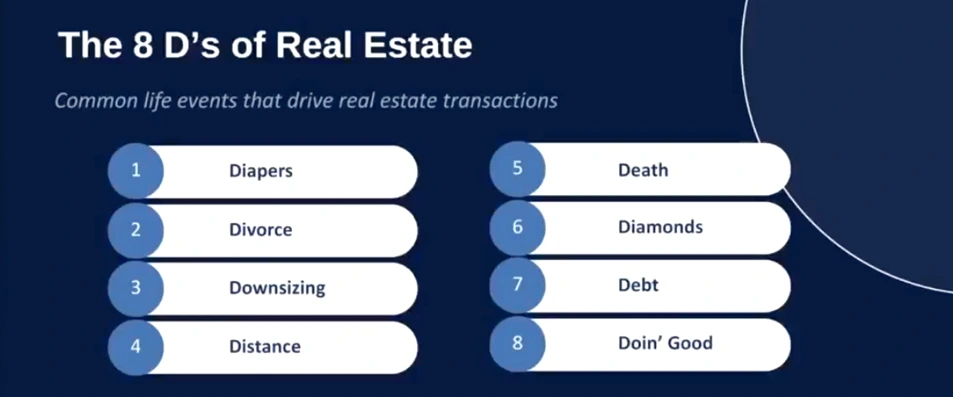
That “why” is what’s driving the transaction, and it shapes how they experience everything that follows.
It’s the same loan process, but a completely different experience. Says Garth, “That’s where the industry gets it wrong. We design around the loan. The borrower experiences it through the lens of their own life event.”
And when no one acknowledges that context — when every communication sounds the same regardless of the situation — the experience starts to feel transactional, even when the service itself is technically sound.
So, in a world where multiple parties are all trying to “own” the borrower, the real differentiator could be better stated as alignment. Who understands why this borrower is here? And who adjusts their approach to meet them in that moment?
So, what determines which voice rises above the rest when borrowers are hearing from multiple parties? It’s not ownership “on paper.” It’s alignment with the borrower experience over time. And each of the five common voices Brian mentions in his article (the LO, the LO’s former company, the brokerage brand or retail brand, the wholesale lender, the servicer) has a real opportunity to earn that position, so long as they approach it intentionally.
But not all voices are created equal. Some have a natural advantage based on proximity and frequency. Others have to work harder to stay relevant. Here’s how each can differentiate and increase their chances of being the one the borrower remembers.
1. The Servicer (Greatest Long-Term Opportunity)
No one has more consistent access to the borrower than the servicer. Monthly touchpoints, account visibility, and ongoing interaction create a massive advantage. But most servicers waste it by defaulting to transactional communication. The servicers who win treat routine interactions as relationship moments.
Loyalty Tip: Build a “predictive outreach layer” on top of standard communications. If a borrower logs in multiple times, views payoff, or checks escrow, trigger a plain-language email or text: “Saw you were reviewing your account. Anything I can help clarify?” Combine behavior-based triggers with simple, human explanations of upcoming events (escrow changes, statements) before confusion sets in.
2. The Original Loan Officer (Strongest Emotional Anchor)
This is where trust is initially built, and when maintained, it can outperform every other voice. But it decays quickly without intentional follow-up. The LOs who win don’t just “stay in touch;” they stay contextually relevant.
Loyalty Tip: Create a “life-of-loan narrative.” Instead of generic check-ins, anchor outreach to milestones: home anniversary, estimated equity growth, local market shifts. Use short, personalized video or voice notes a few times per year to re-establish presence. The goal is to feel like a guide, not a salesperson.
3. The Brokerage or Retail Lending Brand (Force Multiplier)
This voice has reach but risks becoming background noise. Its power comes from reinforcing — not competing with — the LO. The brands that win act as infrastructure for trust.
Loyalty Tip: Build a “co-branded continuity system.” Every borrower-facing touchpoint — status updates, milestone emails, post-close communication — should feel like it’s coming from the same source. Dynamically insert LO contact info, photo, and tone into templated communications so the borrower never experiences a disconnect between “company” and “person.”
4. The Loan Officer’s Former Company (At Risk of Losing Relevance)
This voice is often the most confusing to the borrower and the easiest to ignore if handled poorly. The ones that retain influence simplify instead of compete.
Loyalty Tip: Send a single, well-crafted “transition clarity” message that removes ambiguity: “Here’s what changed, here’s what didn’t, here’s how we can still support you.” Then shift to value-based touchpoints only (market updates, homeowner insights), not retention campaigns. Less volume, more clarity.
5. The Wholesale Lender or Aggregator (Behind-the-Scenes Influence)
This voice rarely has direct borrower access, but it shapes the experience more than most realize. The wholesalers who win don’t try to insert themselves, they elevate the broker.
Loyalty Tip: Develop “broker experience kits” for key borrower moments — short scripts, explainer visuals, and templated messages for appraisal gaps, underwriting conditions, and closing prep. Pair this with real-time status APIs or alerts that help brokers stay ahead of borrower questions. If the broker sounds sharp and prepared, your influence is working.
Across all five voices, the winners are the ones that feel the most consistent, the most helpful, and the most human over time. Automation is necessary to achieve scale, but the lenders who differentiate are the ones who use automation to deliver personalization, not replace it. They connect the dots across interactions so the borrower doesn’t feel like they’re starting over each time.
In the end, borrowers won’t remember who had access to them. They will remember who showed up in a way that mattered. And the voice that does that best is the one that earns the relationship.
To be the voice that gets remembered, you need to intentionally design how it’s heard over time. Here are three ways to do that:
1. Build continuity across the lifecycle
Most lenders think in stages; origination, onboarding, servicing. But borrowers experience one continuous journey. The handoffs between those stages are where relationships break down.
Tactical Tip: Audit your experience at the transition points, especially post-close and servicing transfer. Are expectations being reset clearly? Does the borrower know who to trust now? Are tone and messaging consistent from one touchpoint to the next? The companies who win don’t let the experience “reset” after closing. They carry the relationship forward so the borrower never feels like they’re starting over.
2. Engineer clarity into high-stress moments
Not all touchpoints matter equally. A handful of moments carry outsized emotional weight — closing, escrow changes, unexpected conditions, payment issues. These are the moments where borrowers decide whether they trust you.
Tactical Tip: Instead of reacting to confusion, get ahead of it. Preempt the questions. Explain the “why” before they have to ask. Train your teams and systems to recognize these moments and treat them differently. If you win these interactions, you don’t need to out-communicate everyone else. You’ve already differentiated.
3. Use automation to feel more personal, not less
Automation isn’t the real problem; poorly designed automation is. Don’t just work to send more messages. Send better ones. Messages that are timely, relevant, and feel like they came from a person who understands the borrower’s situation.
Tactical Tip: Layer in behavior triggers, use plain language, and anchor communication to real borrower events, not generic campaigns.
Final Thought: In a world where five different voices are all trying to maintain the relationship, the winner will be the one that feels the most consistent, the clearest, and the most human. Win that race, and you win the relationship.
To find more Customer Experience Tips, click here.
MortgageCX is now integrated with Encompass®! Mike Seminari
Start receiving monthly Customer Experience Tips
Feel free to reach out with any questions or needs we might be able to help with.