Thousands of runners stretch and shake out their limbs to keep their muscles loose. Nervous energy ripples through the corral where runners are wedged together in anticipation of the blast from the air horn signaling the start. Months of training have narrowed to this moment: one long road and 26.2 miles of Chicago ahead.
No one from STRATMOR ran the Chicago Marathon this year. But several of us were there, watching from the sidelines, coffee in hand, cheering on the thousands of brave souls who laced up for the event. We watched as hours of disciplined training and perseverance culminated in one of the most challenging and rewarding experiences a runner can take on.
Race day in Chicago coincided with the opening of the mortgage industry’s biggest event of the year: the Mortgage Bankers Association (MBA) Annual Convention. The mortgage industry is deep into its own marathon, and people who train for 26.2 miles have a surprising amount to teach us about how to finish it.
In his opening remarks, MBA President and CEO Bob Broeksmit acknowledged the challenges facing the industry. Rates remain “well over 7%,” he told attendees, and hopes for a turnaround in 2026 have not materialized.
“Honestly, it’s hard to see the light at the end of the tunnel,” Broeksmit said. Yet he offered some encouragement: “We control more of the future than you may think.” It’s a sentiment familiar to any marathon runner facing the difficult middle miles, when the finish is still out of sight and success depends on preparation, persistence, and determination.
Throughout numerous industry events and conversations with lenders this fall, the STRATMOR team is seeing the same thing. Most lenders are not dropping out of the race. They are deciding how to prepare and position themselves for a strong finish. This month, we share our observations on the forces shaping the course ahead and offer eight lessons from a marathon training plan that we believe lenders, and the technology partners that serve them, should apply now.
Lenders should prepare for another difficult year in 2027. Across industry events, advisory engagements and conversations with lenders and solution providers this fall, six forces stand out:
Lenders are no longer counting on a refinance wave to drive growth. The focus has shifted to executing in a challenging market and making the economics work. Consumer-direct teams remain in place to capture refinance opportunities if they return, but business plans no longer depend on them. Meanwhile, modest productivity gains are being offset by rising technology, commission, and sales costs, keeping pressure on margins. Lenders must focus on improving operational efficiency, controlling expenses, and finding sustainable sources of revenue rather than waiting for market conditions to improve.
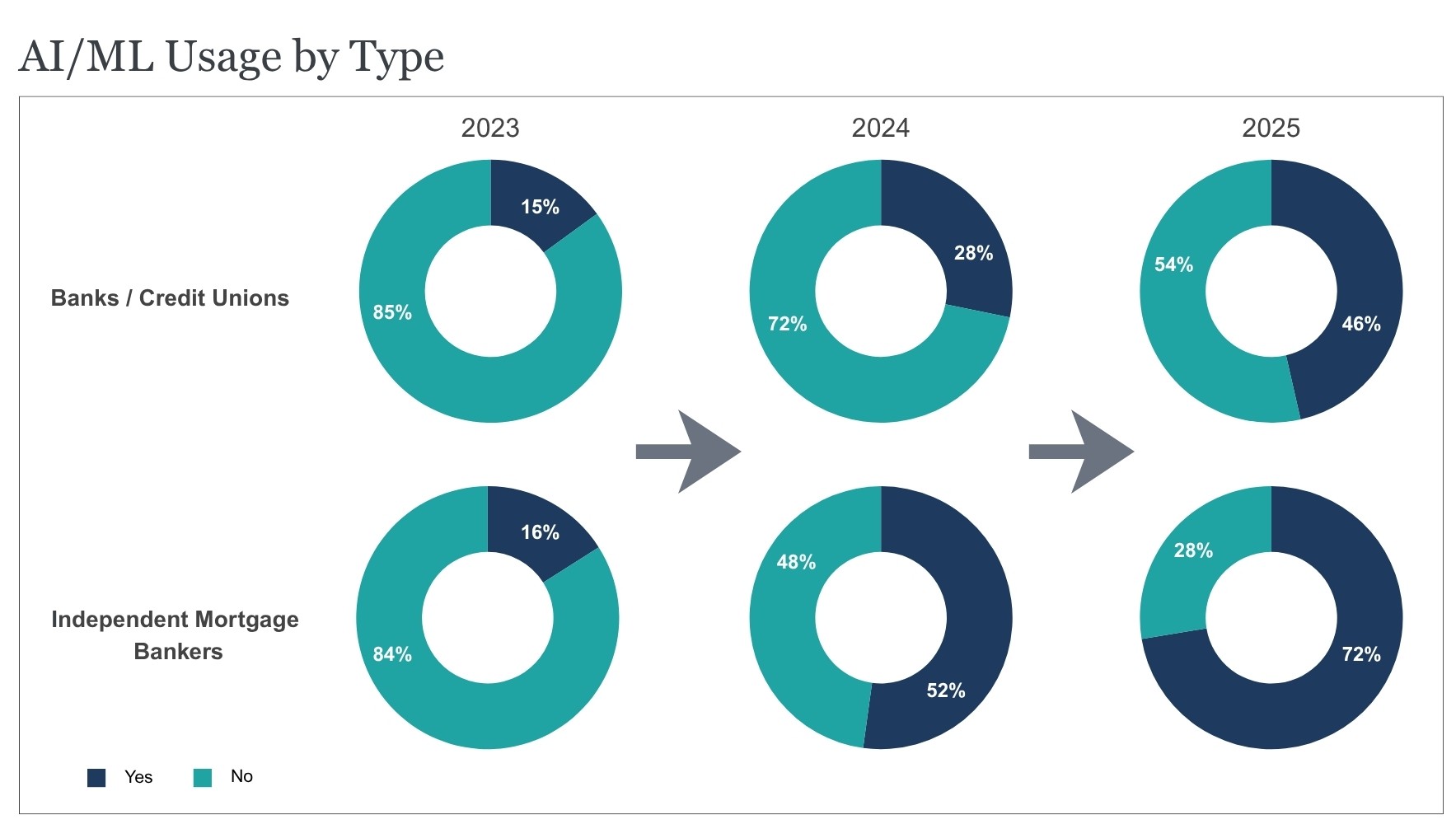
The AI conversation has shifted from education to execution. “The lender mindset is shifting from ‘we’ve got to learn about AI’ to actually working on pilot test cases,” says STRATMOR Senior Partner Nicole Yung. Independents are generally moving faster, while banks continue to navigate governance, risk, and resource challenges within larger, more complex organizations.
Lenders are also less concerned with how technology is labeled and more focused on results. “Lenders don’t care whether a solution uses rules-based automation, machine learning, or true AI. They just want it to work,” Yung says. Some lenders are even building small AI agents in-house and expanding applications beyond origination into financial modeling and scenario analysis.
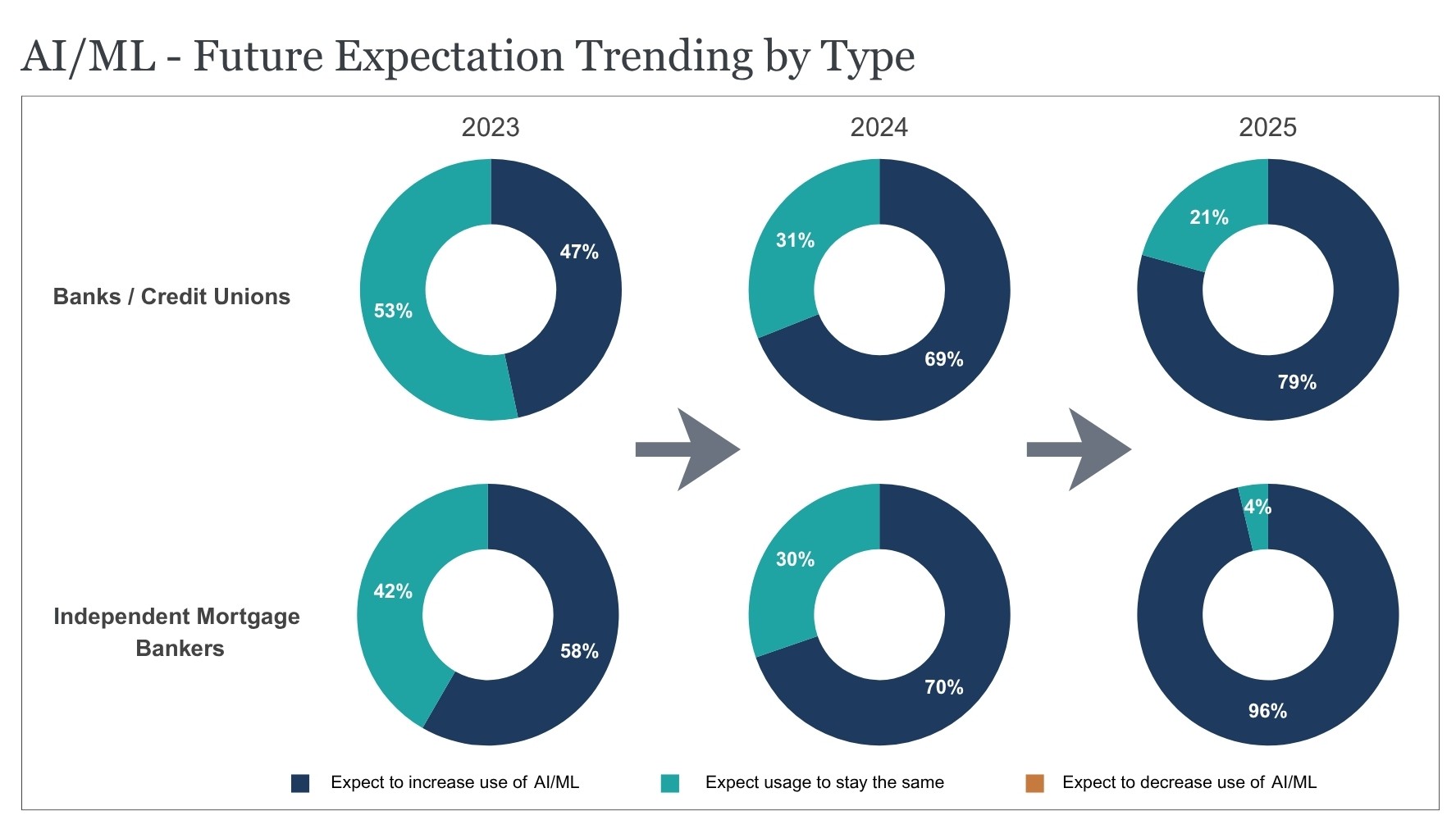
AI adoption is expected to accelerate. In 2023, banks and independents started at roughly 15% AI/ML adoption. In 2025, 96% of independents and 79% of banks and credit unions expected to increase their use, with no lenders reporting plans to reduce their use of AI in the future. Lenders should focus on moving beyond isolated pilots to scalable applications that deliver measurable value, supported by the right governance and oversight.
Source: STRATMOR Group 2025 Technology Insight® Study results.
Technology stability is increasingly hard to find. Lenders are reevaluating or replacing core platforms across loan origination, point of sale, and servicing, but the cost and complexity of those decisions are significant. With vendors rapidly evolving their platforms and new entrants continuing to enter the market, lenders must weigh the benefits of modernization against the risk of investing early in technology that may soon change. Banks must navigate stricter vendor oversight and risk-management requirements, while independent lenders often have greater flexibility to test new technologies. The challenge for all lenders is to look beyond the next system upgrade and assess which technology investments will deliver measurable returns, support long-term business objectives, and provide the flexibility to adapt as the market evolves.
Shifting GSE policies are creating opportunities to rethink credit and verification costs while raising the stakes for operational readiness. With VantageScore gaining acceptance and the future of tri-merge credit reports increasingly uncertain, lenders should evaluate their credit and verification strategies for potential savings and efficiencies. At the same time, the transition to UAD 3.6 brings new data and technology requirements that lenders cannot afford to overlook. Temporary exceptions may provide some breathing room, but lenders should prioritize system readiness, vendor coordination and compliance to avoid costly disruptions and potential loss of representation and warranty relief.
Banks and independent mortgage companies are looking for ways to expand beyond traditional purchase and refinance lending by helping existing homeowners tap into their equity. With many homeowners reluctant to give up historically low first-mortgage rates, home equity is becoming an increasingly attractive growth opportunity for lenders.
Lenders should evaluate their home equity products, technology, and fulfillment capabilities to determine how they can compete effectively in this expanding market. Those that make home equity a strategic part of their business can strengthen customer relationships, create new revenue opportunities, and stay relevant long after the original mortgage closes.
“Competition for talent remains intense, particularly for experienced retail loan originators and brokers,” STRATMOR Senior Partner Garth Graham observes. At the same time, the wholesale channel continues to evolve, and merger and acquisition activity remains an important part of the industry’s conversation. But the race for scale isn’t just about recruiting or consolidation. Lenders are also rethinking how they build operational capacity. Increasingly, they are looking to partners for more than isolated solutions or short-term staffing relief. They want end-to-end support that can improve processes, expand capacity, and incorporate AI and automation to drive efficiency. Lenders should take a hard look at where they need to build, buy, or partner to strengthen their operating models and compete more effectively.
STRATMOR’s advice for the year ahead is simple: the lenders best positioned for 2027 and 2028 will be those making strategic technology, capability, and operational investments now, rather than waiting for the market to recover. Marathoners know that no one improvises on race day; the race is won in the months before. Here are the eight lessons we would take from the training plan, the moves we would make first, and what technology partners should be ready to deliver in support.
In a market where volume can no longer cover for inefficiency, benchmarking is essential. If productivity is improving but technology and sales costs are rising faster, you need to know which side of that trade you are on. It is the foundation we recommend before any major strategic decision. Every marathoner knows their pace, and the runner who goes out too fast at mile three pays for it at mile twenty.
Lenders:
Vendors: Make productivity and cost-per-loan reporting easy to pull from your platform, so customers can see the return on what they bought.
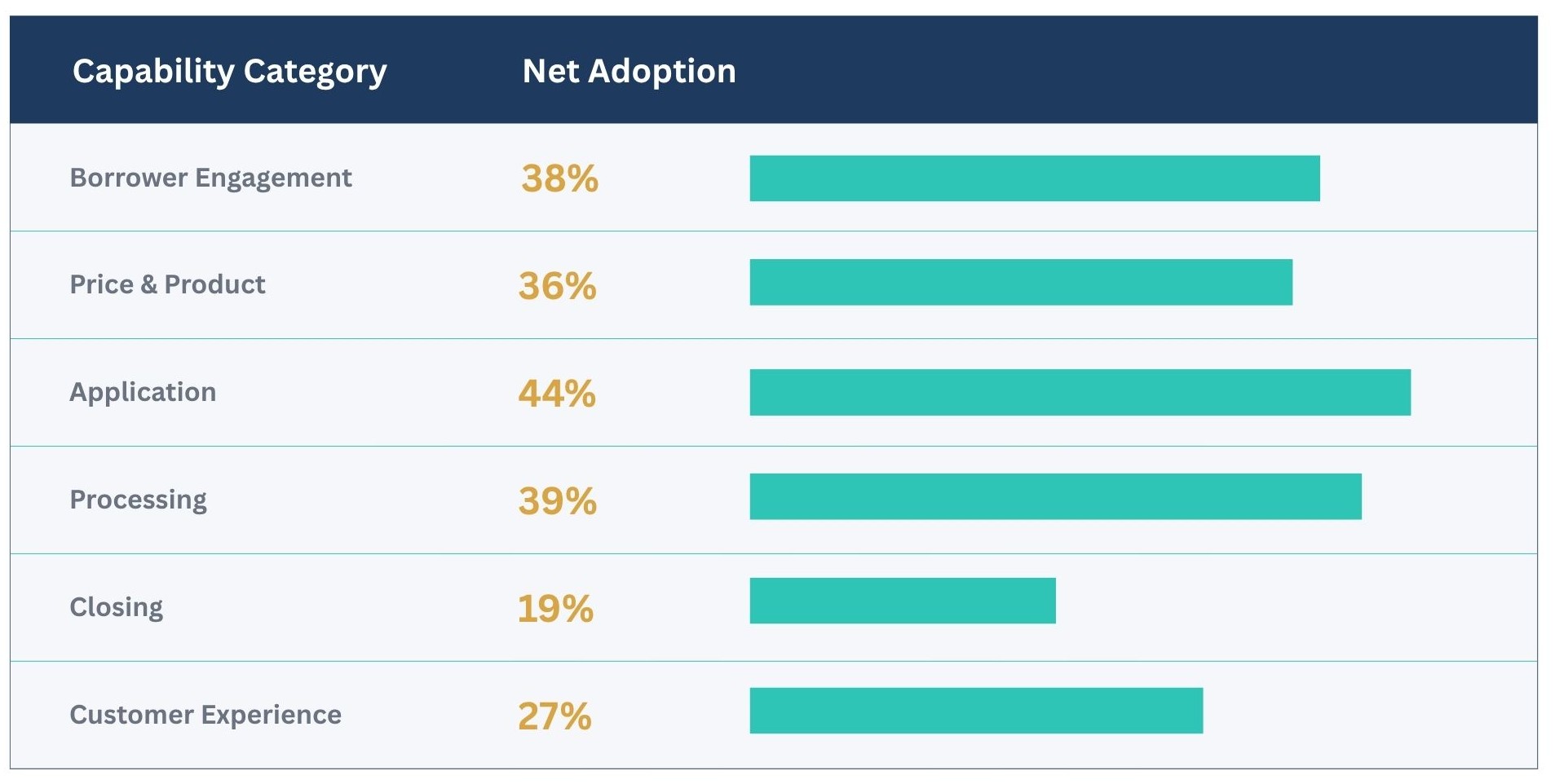
The pilot phase has done its job. Now the work is scaling the use cases that pay off. Training plans build mileage week by week, and nobody jumps from a 5K to 26.2 miles in a single leap. Measure adoption, not just deployment. STRATMOR’s data shows the gap between having a capability and using it is wide: the least-used category, closing, sits at 19% net adoption.
Source: STRATMOR 2025 Technology Insight® Study results.
Lenders:
Vendors: Lead with outcomes, not labels. Show customers the metric that moved, support the change management that drives usage, and be ready to explain your AI to a bank’s risk and approval teams.
With so many lenders mid-replacement and so many new vendors in the market, discipline matters more than speed. Runners learn the hard way not to try new shoes at the starting line. Test it, prove it, then commit.
Lenders:
Vendors: Publish realistic roadmaps, show integration depth, and invest in implementation support. Lenders are choosing partners who will help them successfully implement and adopt new technology, not simply sign a contract.
With VantageScore now accepted by the GSEs for all lenders and the future of tri-merge increasingly uncertain, the economics of mortgage credit reporting are shifting. Smart runners practice their fueling long before race day so every calorie counts, and lenders should treat every dollar of per-loan cost the same way.
Lenders:
Vendors: Credit reporting agencies, LOS and POS providers, and appraisal software companies should have clear answers on integration and timing before lenders ask.
Home equity lets lenders grow from existing customer relationships instead of hoping for lower rates, a refinance wave or a stronger purchase market. Think of home equity as cross-training: building new strength without waiting for race-day conditions to improve. Banks that are not seriously considering it may be leaving a significant opportunity on the table.
Lenders:
Vendors: Home equity platforms, POS providers, and servicing data partners that can plug into a lender’s existing origination and customer data will have the advantage.
Many lenders say they deliver a great customer experience; far fewer measure it. Without volume growth to hide weak spots, retention and competitiveness depend on getting it right. Runners get gait analysis because flaws in their stride that they cannot feel still cost them miles. Secret shopping does the same for the borrower journey.
Lenders:
Vendors: Expect lenders to ask for experience metrics, not just feature lists, and be ready to show how your product improves them.
The fight for LOs will continue, and consolidation is a major theme. Few people run a marathon alone; pace groups, coaches and aid stations are what make the distance possible. Strategic conversations do not have to start with a sale; they can start with options, positioning, acquisitions, mergers, or just understanding where the market is going. STRATMOR’s M&A team is extremely active, and the lenders making big strategic moves are often the ones who started these conversations early.
Lenders:
The policy backdrop may be turning more favorable, and it affects planning. Runners cannot control the weather, but they check the forecast and adjust their plan. At the MBA Annual Convention in Chicago, Chair Owen Lee reported that “abusive trigger leads are mostly dead and gone,” while MBA’s new Affordability in Action campaign includes more than twenty reforms. Broeksmit said the administration is considering revisions to the loan officer compensation rule, and Lee indicated that a final Basel III rule is expected by year-end.
Lenders: Model how a revised LO compensation rule and a final Basel III rule could change your pricing, channel mix and bank partnerships, so you can act when details land. STRATMOR’s strategic advisors can help you think through those scenarios.
Vendors: Anticipate how regulatory changes could reshape lender priorities. Revisions to loan officer compensation rules, Basel III, and other policy changes could influence lenders’ technology budgets, channel strategies, and operational needs. Reassess your product roadmap and be prepared to demonstrate how your solutions help lenders adapt, manage risk, and capitalize on emerging opportunities.
No one on the Annual stage, or in our recent work and conversations with lenders, promised an easy course in 2027. The hills are real, and so is the uncertainty about what’s around the next bend for the mortgage industry.
But marathons are not won in the final mile. They are won in the months of training before the starting gun, in the early mornings, the honest assessments, and the discipline to adjust the plan when the data says to.
The same is true in mortgage lending. The lenders that come out ahead in 2027 will be the ones that start now: benchmarking performance against their peers, piloting new technology before they commit to it, rationalizing what no longer earns its place, diversifying beyond a single product or channel, and planning for the scenarios they hope to avoid as carefully as the ones they expect.
STRATMOR can be your coach for the miles ahead:
The lenders that finish strong in 2027 will be the ones that treat the coming months as training time, not waiting time. Each of these steps builds the foundation for what comes next.
Don’t wait for the final mile to find out whether you’re ready. Contact us today to learn more.
STRATMOR works with bank-owned, independent and credit union mortgage lenders, and their industry vendors, on strategies to solve complex challenges, streamline operations, improve profitability and accelerate growth. To discuss your mortgage business needs, please Contact Us.


Feel free to reach out with any questions or needs we might be able to help with.