Every four years, the FIFA World Cup gives us a masterclass in human emotion: agonizing heartbreaks on the pitch, euphoric late-game winners, and a planet momentarily united by a single rolling ball. It is more than a tournament; it is a global theater where history is written in ninety-minute chapters.
Beyond the human element, the World Cup offers a useful metaphor for how high-performing organizations execute under pressure. For mortgage leaders, the World Cup offers a reminder that success is rarely built on individual talent alone. The teams that go the furthest are the ones that trust each other to execute, possession after possession and match after match. A midfielder releases the ball because he knows a teammate will be where he is supposed to be. A defender steps forward because he trusts the rest of the back line to move with him. Over time, that confidence becomes more than chemistry; it becomes the operating system that allows the team to perform under pressure.
As a mortgage lender or MSR owner, your relationship with your subservicer should work the same way. Choosing a subservicer is not simply selecting a vendor or outsourcing a function. It is choosing a partner that represents your organization to borrowers every day, often during interactions you’ll never witness firsthand. That relationship must hold up through regulatory scrutiny, operational complexity, changing market conditions, and thousands of borrower interactions.
Subservicing is now a mainstream operating model. The real question now is: how do you choose the right partner and ensure that partnership creates value rather than risk?
Earlier this year, STRATMOR launched a Subservicing Market Survey to a senior audience of MSR owners across independent mortgage bankers, banks, and credit unions to better understand how lenders are choosing, using, and rethinking their subservicer relationships. MSR owners representing 68 unique companies and roughly 9.8 million loans participated. Respondents included CFOs, presidents, EVPs and SVPs of servicing, and VP-level lending and operations leaders — the people who actually make these decisions. The results offer a candid look at how the market is shaping up, and what lenders are asking for.
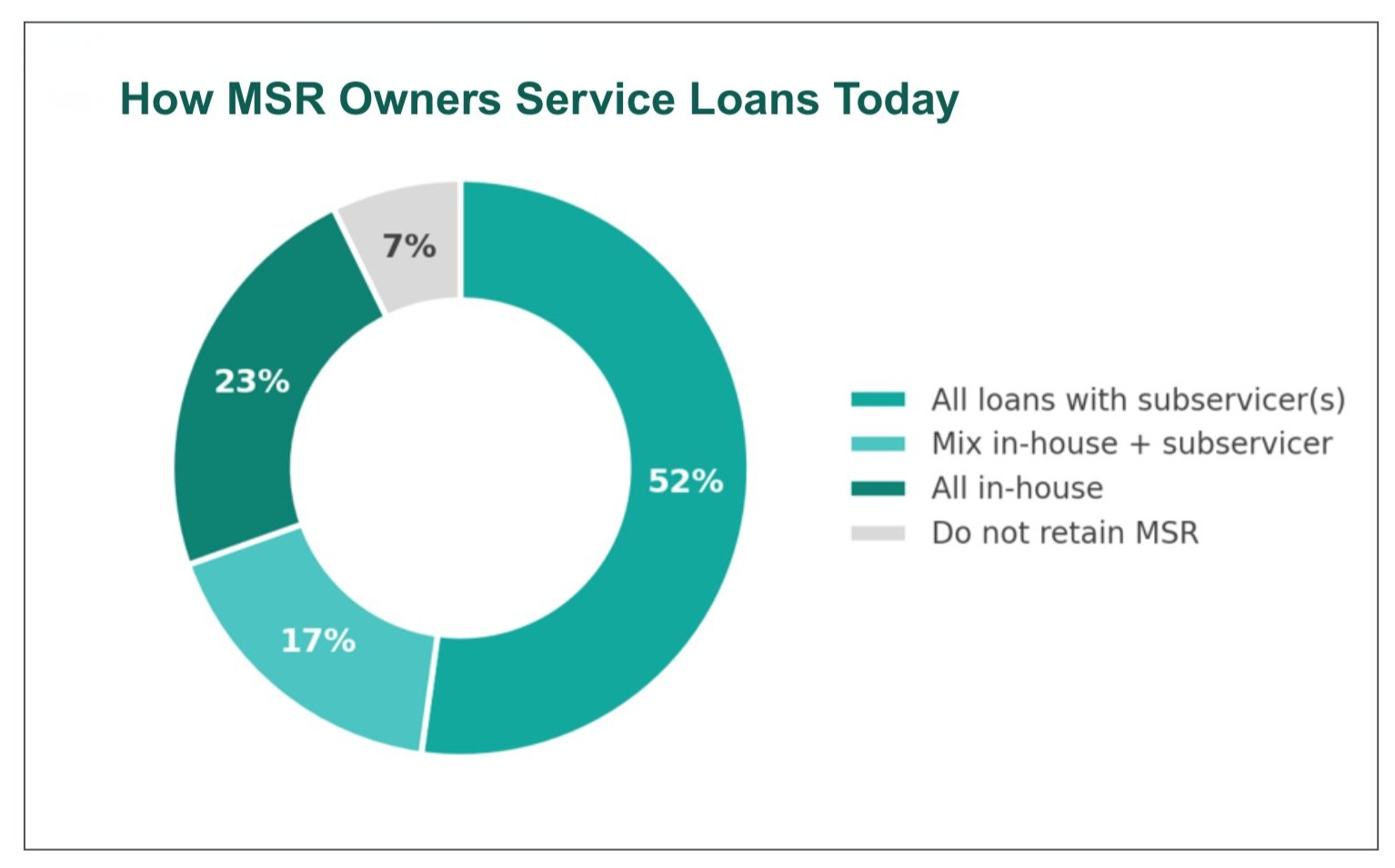
The first question every MSR owner must answer is how much of the servicing function you want to delegate. Roughly seven in ten MSR owners in our survey use a subservicer for at least part of their portfolio, and just over half outsource their entire book. Only 23% service all loans in-house. Subservicing is not a niche choice; for many mortgage lenders, it is the standard operating model.
Source: STRATMOR 2026 Subservicing Market Survey results.
If you have already decided to use a subservicer — or are considering it — the next critical decision is how many subservicer relationships you are willing to manage.
Among MSR owners who use a subservicer, 83.3% said their ideal number of subservicer relationships is exactly one. This preference is not about vendor loyalty or convenience. It is about operational reality.
Managing multiple subservicers means managing multiple:
If this is your operating model, adding a second subservicer can mean doubling your internal management burden without a corresponding doubling of value. That math rarely works, which is why most lenders prefer, and should start their evaluation around, a single primary relationship.
For your organization: If you are considering subservicing for the first time, or evaluating a change, plan around managing one primary relationship. Build your RFP and evaluation criteria for a subservicer who can handle scale, complexity and your portfolio’s specific needs.
Before you evaluate specific capabilities or pricing, you need to determine what your organization wants from a subservicing relationship. The data from our survey reveals a clear hierarchy:
1. Confidence That the Model Works
Lenders are asking who has already proven they can manage scale, meet compliance expectations, support borrowers well and protect reputation over time. In open-ended survey responses, lenders cited “established,” “compliant” and “proven size” far more often than technology features. This is not about being conservative for its own sake. It is about recognizing that when you outsource the borrower relationship, the operational and compliance risks become your responsibility regardless.
For your organization: Before you evaluate a new subservicer, understand their performance history.
Ask for references from similar-sized lenders and portfolio types. Do not rely on pitch materials for this. Instead, ask the key reference questions.
2. Borrower Experience That Reflects Your Brand
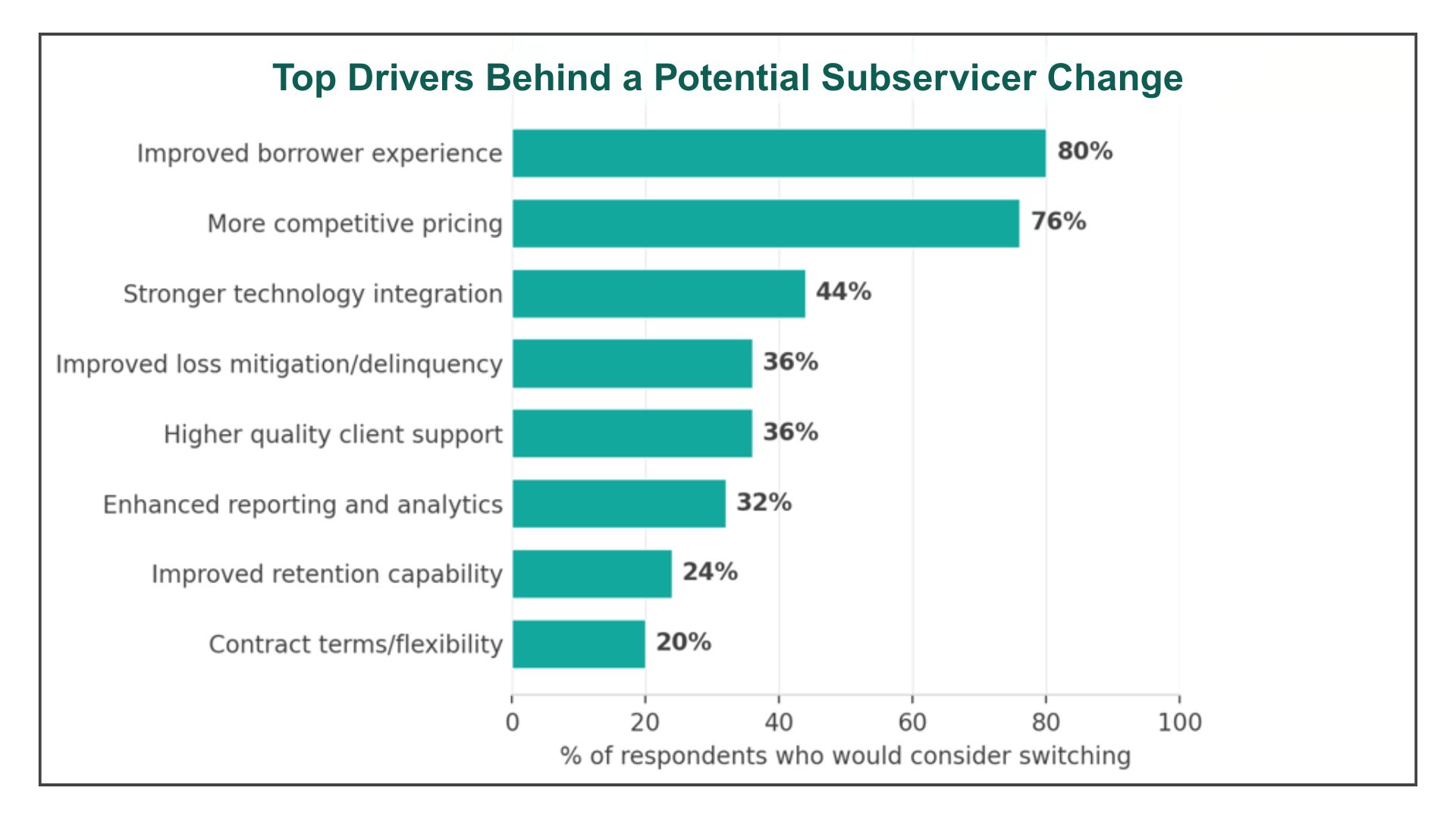
Our survey found that among lenders open to switching providers, borrower experience edged out price as the top consideration: 80% cited improved borrower experience as a driver; 76% cited more competitive pricing.
Source: STRATMOR 2026 Subservicing Market Survey results.
Order does matter. When your subservicer answers a borrower’s call, the borrower often attributes that experience to your company. Your subservicer’s borrower experience becomes part of your brand promise. That makes the quality of borrower care a strategic decision, not just an operational one.
For your organization: Include borrower experience metrics in your subservicing RFP and contract. Define what “good” looks like:
Get baseline metrics from your candidate subservicers and include them in your contract with teeth (service-level agreements with remedies if they miss targets). Treat borrower experience as a brand control, not a commodity. Price matters. It ranks second in our switching drivers, and it remains a strong consideration in any evaluation. But lenders who base their subservicing decision on price alone often find themselves back in the market within a few years.
In STRATMOR’s advisory work, price often opens the evaluation. But borrower experience, compliance posture, integration capability and demonstrated reliability usually determine who wins. Lenders that focus solely on price often discover hidden costs: compliance issues that require remediation, customer attrition, and integration problems that require additional internal resources. Lenders that switch on a combination of price, demonstrated capability and reliability are more likely to stay.
For your organization: Use pricing as a qualifying criterion, but not the deciding criterion. Get competitive bids but require that each bid includes a clear cost of transition (conversion costs, system integration, internal resource time), ongoing operational metrics (compliance audit costs, regulatory reporting costs), and any volume-based escalations. Compare total cost of ownership, not just per-loan servicing fees. If a bid looks suspiciously low, ask why. Usually, the answer reveals where costs are being hidden.
If lenders are satisfied with their current subservicer(s), the survey data shows why lenders tend to stay. The leading reasons are straightforward: strong overall satisfaction, compliance confidence, effective delinquency management and borrower experience. These are not features; they are outcomes. When a relationship works, the inertia is real.
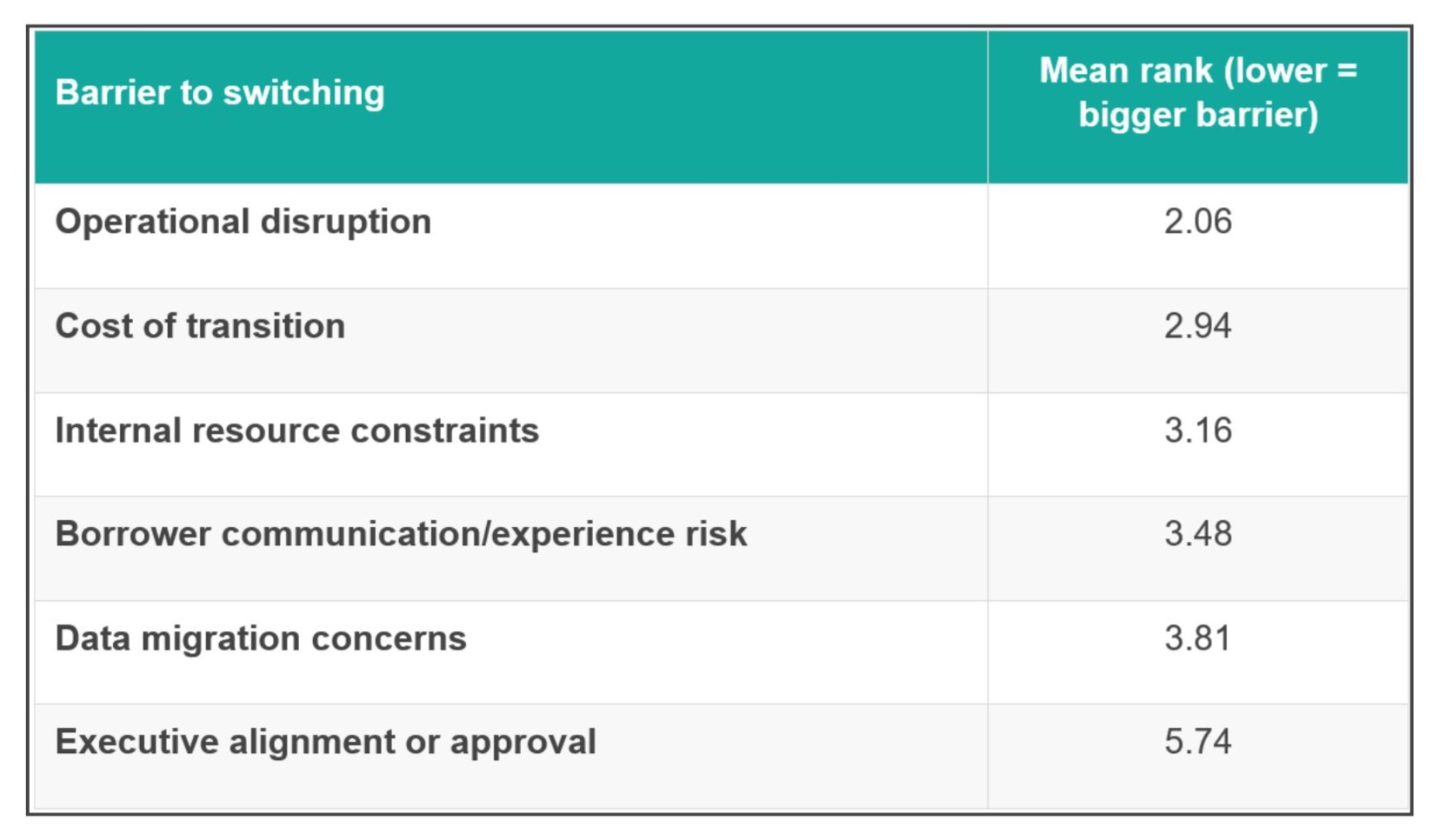
But what if you are considering a change? The barriers are often operational rather than strategic:
Source: STRATMOR 2026 Subservicing Market Survey results.
The fact that operational disruption ranks highest is the real insight. Leadership often favors a change; the hard part is executing one cleanly. This is where most lender decision-making falls apart.
For your organization: If you are seriously considering a subservicing change, do not evaluate the potential provider in isolation. Evaluate them with their transition plan.
The quality of the provider’s transition planning often matters more than their steady-state operations capabilities, because a botched conversion can damage your borrower relationships for months.
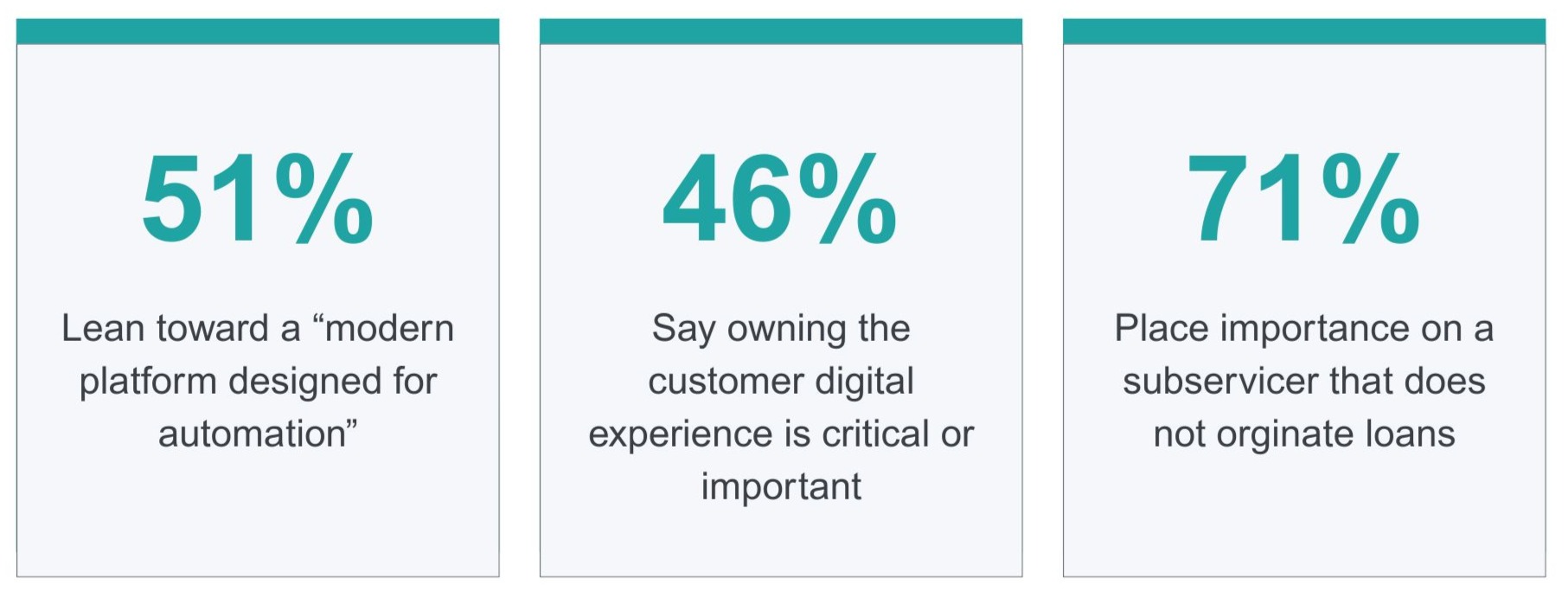
Beyond switching drivers and barriers, three buyer preferences reveal what lenders are actually prioritizing. Use these as a framework for your evaluation:
Source: STRATMOR 2026 Subservicing Market Survey results.
In our survey, respondents were almost evenly split between preferring a modern platform designed for automation and an established platform with a proven track record. This split reflects different risk appetites among lenders.
If you are primarily concerned with speed, flexibility and access to the latest automation capabilities, a newer platform may be worth the higher technology risk. If you are primarily concerned with stability, audit history and predictability, an established platform may be the better choice. There is no universal right answer. Your choice should align with your portfolio, operating model and tolerance for change.
For your organization: Be honest with yourself about your risk appetite. What matters more to you: having the newest technology, or having a platform with a 10-year track record? This question should shape your initial screening of candidates.
Nearly half of survey respondents said it is critical or important that they own the customer’s digital experience through private-label borrower portals, white-labeled communications, and direct control over borrower touchpoints. This is one of the clearest signs that lenders want the benefits of outsourced scale without losing the brand relationship.
If borrower relationship ownership is important to your strategy, you need a subservicer that can offer white-label capabilities, allow you to control the visual and messaging brand, and give you direct access to borrower communication logs and satisfaction data.
Self-serve capabilities are no longer “nice to have”—they’re a core driver of borrower satisfaction and an increasingly important differentiator when evaluating (or retaining) a subservicer.
A strong subservicer should provide multiple pathways for borrowers to accomplish common tasks:
For your organization: Before you sign an agreement, confirm exactly what borrower touchpoints you will control (portal look and feel, email templates, phone IVR branding, etc.). Include those controls in your contract. If a subservicer is cagey about white-label options, look elsewhere.
71% of survey respondents said it is important or very important that their subservicer not also originate loans. The concern is practical: if your servicing partner also originates, they have access to your borrower base and economic incentive to compete for future originations or refinancing business.
One respondent noted: “Sub-servicers who also originate loans are perceived as competitors for our clients.” This is not a hypothetical concern. It reflects real business dynamics that lenders have experienced.
For your organization: If you rely on your borrower base for future originations or refinances, a subservicer that also originates represents a competitive concern. Make sure your contract includes clear language around client confidentiality, restrictions on competitive outreach, and dispute resolution if you believe your borrowers are being contacted for competitive purposes.
The through-line in the 2026 survey is clear: lenders want a subservicer they can trust with the borrower, the brand and the operational complexity of servicing. That trust is not built by a single capability or sales message. It is built through evidence that the provider will perform consistently and make your job easier.
Here is what you should consider:
Just as important is how often you evaluate the relationship. Establish a fixed cadence: monitor operational and borrower-experience metrics monthly, hold a formal performance and compliance review with your subservicer quarterly, and conduct a comprehensive annual assessment against your service-level agreements and the goals you set at selection. Every two to three years, benchmark your subservicer against the broader market, not necessarily to switch, but to confirm your pricing, technology, and borrower experience remain competitive. Regular, disciplined evaluation keeps small issues from becoming systemic ones and ensures the relationship continues to earn your trust rather than retaining it by inertia.
Subservicing is a mature, central operating model for many mortgage lenders. The question is no longer whether to use a subservicer, but how to select and manage that relationship for maximum value and minimum risk.
Your subservicing choice will shape your borrower experience, your compliance exposure, your operational burden and your bottom line for years. The lenders in our survey understand this. They are asking hard questions about confidence, capability and reliability. These lenders are treating subservicing as a strategic decision, not a procurement decision. You should too.
STRATMOR has worked with mortgage lenders and MSR owners for more than four decades on the strategic and operational questions behind these decisions. Our advisory team helps translate “what we want in a subservicer” into practical evaluation criteria, RFP design, scorecards, contract priorities and conversion oversight, so your decision is grounded in your portfolio economics, borrower experience goals, compliance expectations and risk tolerance.
If you would like to discuss what these findings mean for your organization, please contact us. Nicole Yung
STRATMOR works with bank-owned, independent and credit union mortgage lenders, and their industry vendors, on strategies to solve complex challenges, streamline operations, improve profitability and accelerate growth. To discuss your mortgage business needs, please Contact Us.


Feel free to reach out with any questions or needs we might be able to help with.